

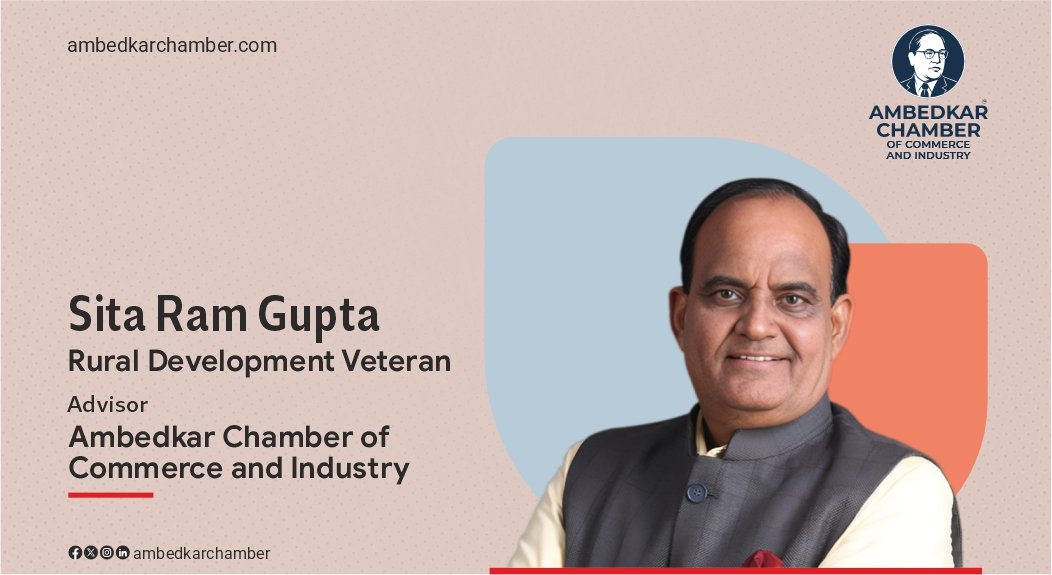

Sita Ram Gupta is one of India’s foremost architects of district-led rural development and a pioneering force in CSR-driven transformation of backward regions.
Sita Ram Gupta currently advises the Ambedkar Chamber of Commerce and Industry, bringing decades of leadership in rural development and economic empowerment.
Sita Ram Gupta (75 Years) is a pioneering leader in India’s rural reconstruction movement and a visionary architect of district-led development. With over four decades of dedicated public service, he has transformed backward regions through sustainable livelihood models, CSR-driven interventions, and policy-shaping innovations that place empowerment, dignity, and self-reliance at the heart of national development.
Lifelong Commitment to Rural India
Sita Ram Gupta has demonstrated unwavering commitment towards serving rural India, a crucial step towards building a resurgent India. His journey of rural reconstruction began in 1986 during the electrification of Somka Village in Bharatpur district, Rajasthan, following the visit of former Prime Minister Rajiv Gandhi. Deeply immersed in understanding rural realities through electrification work, and driven by compassion for the poor, he took a life-altering decision to quit his secure government job. He pledged his life to uplift and empower the poor and vulnerable through healthcare and nutrition, education and skill development, basic infrastructure, women empowerment, and poverty eradication.

Transition from Engineer to CSR Pioneer
His passion for rural reconstruction found concrete direction when he was encouraged by Dr. Desh Bandhu Gupta, Founder and then Chairman of Lupin Limited. Accepting the challenge with conviction, Sita Ram Gupta relinquished a promising government career and joined Lupin’s CSR initiatives. Alongside Dr. Desh Bandhu Gupta, he emerged as one of the earliest pioneers of Corporate Social Responsibility in India, focusing on replicable and sustainable rural development models beyond factory locations and native districts, particularly in backward regions of the country.
Convergence and Collaborative Development
Sita Ram Gupta successfully created rare and effective convergence among diverse stakeholders, including local communities, CSR agencies, government departments, financial institutions, NITI Aayog, think tanks, and multilateral agencies. His collaborative approach ensured that development was not fragmented but integrated, strategic, and scalable. This convergence became a cornerstone of his district-level development philosophy.
District Development Approach and Employment Creation
Through his unique district development approach, Sita Ram Gupta has lifted lakhs of people out of poverty across multiple districts and generated hundreds of thousands of jobs. He is widely known for creating sustainable, locally rooted, and long-term employment solutions rather than relying on aid-based welfare models. His focus on viable economic entities at the district level marked a shift away from traditional village-centric development thinking.
Innovation in Livelihoods and Natural Resource Use
One of his most notable contributions was unlocking the latent potential of districts through innovative livelihood practices. In Bharatpur, he introduced beekeeping based on local flora and fauna—an unheard-of practice two decades ago—transforming the region into a globally recognized honey-export hub. Similarly, his visionary leadership converted waterlogged lands into productive fish farming ponds, establishing Bharatpur as a major fish farming center.
Economic and Social Returns through CSR Models
The District Development Model evolved over time and delivered remarkable economic and social outcomes. Two districts alone generated additional income exceeding US$86 million through holistic development programmes. Social returns from education, health, and women development initiatives further added an estimated US$62 million per district. Sita Ram Gupta demonstrated that strategic use of CSR funds, combined with government schemes, can transform backward districts and significantly contribute to India’s aspiration of becoming a five-trillion-dollar economy.
Influence on National Policy Frameworks
Sita Ram Gupta’s district development approach influenced national policy thinking and was adopted by NITI Aayog in sectoral interventions, ultimately contributing to the Aspirational Districts Programme. His work in Bharatpur further inspired the Aspirational Blocks Programme, leading to the Government of India identifying 500 aspirational blocks nationwide. In Rajasthan, his guidance led to the launch of the Guru Golwalkar Aspirational Block Development Programme, expanding focused development to 41 additional blocks.
Empowerment Line and Grassroots Institutions
Moving beyond conventional poverty metrics, Sita Ram Gupta adopted the McKinsey Empowerment Line, emphasizing holistic improvements in quality of life rather than calorie-based poverty definitions. He empowered communities through Gram Vikas Panchayats (GVPs), enabling grassroots leadership in development. This empowerment-focused model is now operational in 23 districts, helping people rise above the Empowerment Line through participatory and sustainable development.
Vision for Future Growth and District GDP
Sita Ram Gupta envisioned model blocks, villages, schools, PHCs, CHCs, and Anganwadi centers as the foundational grid of development. He introduced the concept of Resurgent Villages with a strong focus on non-farm employment, recognizing that three- and four-tier towns would become future growth engines. Believing that national GDP is the aggregate of district GDPs, he outlined strategies to enhance the economic output of aspirational and middle-level districts, aiming for India to achieve a US$7.5–9 trillion economy by 2030 and developed nation status by 2047.
Enduring Legacy and Ongoing Mission
From an electrical engineer to a transformative force in rural reconstruction, Sita Ram Gupta’s four decades of public service have impacted every sphere of development. Beyond advising state governments, he has played an instrumental role in shaping pro-poor and pro-people policies. At over 75 years of age, his passion remains undiminished. He currently leads Samriddh Gramya Abhiyan Society and Samridh Bharat Abhiyan Trust in Bharatpur, Rajasthan.
His mission is to place poverty in the museum where it truly belongs.
As India moves forward, his philosophy of “scale + innovation + purpose” stands as a guiding light for building a truly developed India.
In recognition of his outstanding contributions to the country, appreciations, accolades, and awards of national/international stature not only further ignite his passion but also motivate him to do his work more enthusiastically and passionately, as India needs to scale up in the developmental arena due to its huge population.
Disclaimer: This article is based on an in-depth interview with Sita Ram Gupta, conducted by Rusen Kumar, National President of the Ambedkar Chamber of Commerce and Industry.
©ambedkarchamber.com