


Standard Released on National Consumer Day 2025
NEW DELHI: India has taken an important step to build consumer trust and safety in electric farm machinery by launching a dedicated test standard. On 28 December 2025, Union Minister for Consumer Affairs, Food & Public Distribution, Pralhad Joshi, released IS 19262: 2025 – “Electric Agricultural Tractors — Test Code” during National Consumer Day 2025 celebrations at Bharat Mandapam, New Delhi. The standard was developed by the Bureau of Indian Standards (BIS) to ensure safety, reliability, and performance of electric agricultural tractors through uniform and scientifically defined testing protocols. This is significant because electric tractors are a fast-growing segment in India, but until now there was no dedicated standardized testing system to assess them consistently. The standard aims to protect consumers, support manufacturers with clear testing benchmarks, and boost confidence among farmers who may adopt this emerging technology for sustainable farming operations.
✅ Facts Table -1
| Key Fact | Details |
|---|---|
| Announcement Date | 28 December 2025 |
| Released By | Union Minister Shri Pralhad Joshi |
| Occasion | National Consumer Day 2025 |
| Venue | Bharat Mandapam, New Delhi |
| Standard Released | IS 19262: 2025 |
| Developed By | Bureau of Indian Standards (BIS) |
| Main Objective | Safety, reliability, and performance assurance |
What IS 19262:2025 Covers – Uniform Testing Protocols
The strength of the new standard lies in its detailed test framework that ensures fair and consistent evaluation across electric tractor models.
IS 19262:2025 establishes a common understanding among stakeholders by defining uniform terminology, testing guidelines, and a structured list of tests to be conducted on electric agricultural tractors. It includes performance testing such as PTO (Power Take-Off) power, drawbar power, and the performance of mechanical parts like belts and pulleys, which are crucial for field operations.
The standard also includes vibration measurements, verification of technical specifications, and inspections of various components and assemblies. These protocols are essential because electric tractors rely on battery systems and electric motors, and their testing must match their unique operating characteristics. Uniform testing procedures will help reduce inconsistencies, support quality assurance, and ensure that electric tractors meet expected performance levels under real agricultural usage conditions.
✅ Facts Table -2
| Testing Aspect | Included in IS 19262:2025 |
|---|---|
| Terminology & Guidelines | Yes |
| PTO Power Test | Yes |
| Drawbar Power Test | Yes |
| Belts & Pulleys Performance | Yes |
| Vibration Measurement | Yes |
| Specification Verification | Yes |
| Component & Assembly Inspection | Yes |
Technical Foundation and Implementation Benefits
The standard has been developed on strong technical references and is designed to support India’s clean agricultural innovation ecosystem.
IS 19262:2025 draws technical assistance from IS 5994:2022 – Agricultural Tractors Test Code and relevant Automotive Industry Standards for electric vehicles, adapted for agricultural use. Its implementation through authorized testing institutes will encourage reliable assessment and easier adoption of electric tractors nationwide. BIS expects the test data generated under this standard to provide a scientific basis for evaluating performance and safety.
This data will also support future development of acceptance criteria and conformity assessment schemes tailored specifically for electric agricultural tractors. By prescribing uniform procedures, the standard supports manufacturers in delivering safer and dependable products. At the same time, it gives farmers greater confidence in the performance capabilities of electric tractors. It also promotes innovation in clean agricultural technologies and supports India’s broader mission of reducing emissions from mechanized farming.
✅ Facts Table -3
| Key Fact | Details |
|---|---|
| Technical Support Taken From | IS 5994:2022 |
| EV Standards Referenced | Automotive Industry Standards |
| Adaptation | Modified for agricultural use |
| Testing Agencies | Authorized testing institutes |
| Outcome Expected | Scientific performance & safety evaluation |
| Future Use | Acceptance criteria & conformity schemes |
| Larger Goal | Innovation + reduced emissions |
Electric Tractors – A Cleaner and Farmer-Friendly Alternative
Electric agricultural tractors are emerging as an effective solution for sustainable farming and reduced dependence on diesel.
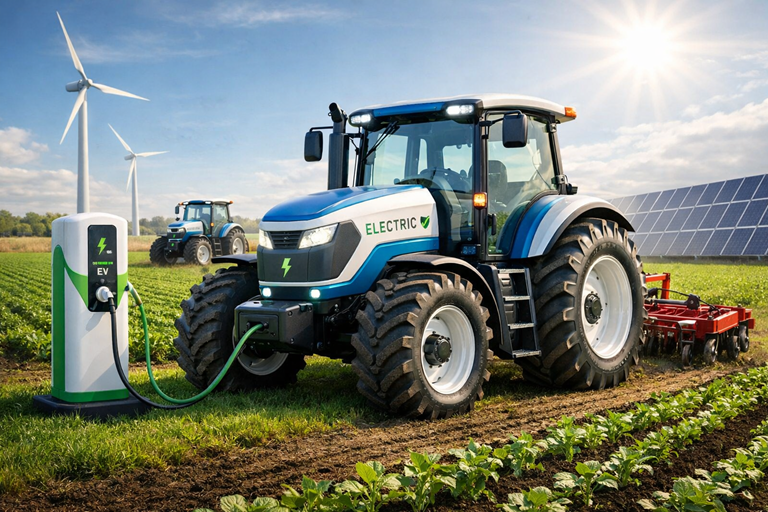
Electric agricultural tractors use electric motor(s) powered by battery packs, replacing conventional diesel engines for propulsion and field operations. They offer major advantages such as reduced emissions, lower operating costs, and improved energy efficiency. Since they eliminate tailpipe emissions at the farm level, they directly reduce air pollution and the carbon footprint of agricultural activities.
For farmers working long hours, electric tractors provide a healthier environment due to significantly lower noise and no exhaust fumes. Their design also offers reduced maintenance because electric systems have fewer moving parts than diesel engines. These tractors help reduce diesel consumption in agriculture, supporting India’s energy security and reducing reliance on fossil fuels. With rapid advancements in battery technology, electric motors, and power electronics, electric tractors are evolving into efficient, capable, and reliable machines—making standardized testing even more essential for safe large-scale adoption.
✅ Facts Table -4
| Benefit Area | Electric Tractor Advantage |
|---|---|
| Emissions | Eliminates tailpipe emissions |
| Noise | Significantly lower |
| Farmer Health | No exhaust fumes |
| Maintenance | Lower due to fewer moving parts |
| Operating Cost | Lower |
| Energy Efficiency | Higher |
| Fuel Dependency | Reduces diesel usage |
| Technology Growth | Battery & motor advancements |
Why the Standard Was Needed and Who Contributed
The standard was developed because rising adoption of electric tractors required a dedicated, harmonized testing framework for consistent evaluation.
As electric tractor adoption increases in India, the lack of dedicated testing standards posed serious challenges in assessing performance, safety, and reliability uniformly. Responding to this gap and a priority request from the Mechanization & Technology Division of the Ministry of Agriculture & Farmers’ Welfare, BIS took up the formulation of this Indian Standard.
The process included active contributions from electric tractor manufacturers, testing and certification agencies, research and academic institutions, and experts in agricultural engineering and electric mobility. Institutions such as ICAR-Central Institute of Agricultural Engineering (Bhopal), Central Farm Machinery Training and Testing Institute (Budni), Automotive Research Association of India (Pune), and farmer organizations participated in shaping the standard. Although IS 19262:2025 is voluntary, its notification is a major milestone in strengthening India’s standardization framework for emerging agricultural technologies and aligning domestic practices with international electric mobility and mechanization trends.
✅ Facts Table -5
| Key Fact | Details |
|---|---|
| Reason for Standard | No harmonized testing earlier |
| Priority Request From | Ministry of Agriculture & Farmers’ Welfare |
| BIS Action | Formulated test standard |
| Stakeholders Included | Manufacturers, agencies, experts, institutions |
| Major Contributors | ICAR-CIAE, Budni Institute, ARAI Pune, Farmers Alliance |
| Standard Nature | Voluntary |
| National Impact | Strengthened standardization framework |
| Global Alignment | Electric mobility + mechanization trends |