


Tuna production has grown steadily from about 500 tonnes in the 1950s to 16,891 metric tonnes in 2024–25, reflecting both ecological resilience and institutional support.
The concept of “Lakshadweep Sustainable Tuna” emerges at the intersection of marine ecology, traditional knowledge systems, global seafood markets, and sustainable development policy. Lakshadweep, a group of coral islands in the Arabian Sea, occupies a strategically significant position within India’s maritime geography. The islands are located in waters that form nearly 20 percent of India’s Exclusive Economic Zone (EEZ) and are naturally endowed with rich stocks of tuna and other pelagic species.
Despite this ecological advantage, tuna production in Lakshadweep remains relatively modest—estimated at around 15,000 tonnes annually, against a scientifically assessed potential of nearly one lakh tonnes. This gap between potential and production has prompted policymakers and researchers to explore development pathways that do not compromise marine ecosystems. The idea of “Lakshadweep Sustainable Tuna” must be understood within this broader context of responsible resource utilization rather than extractive expansion.
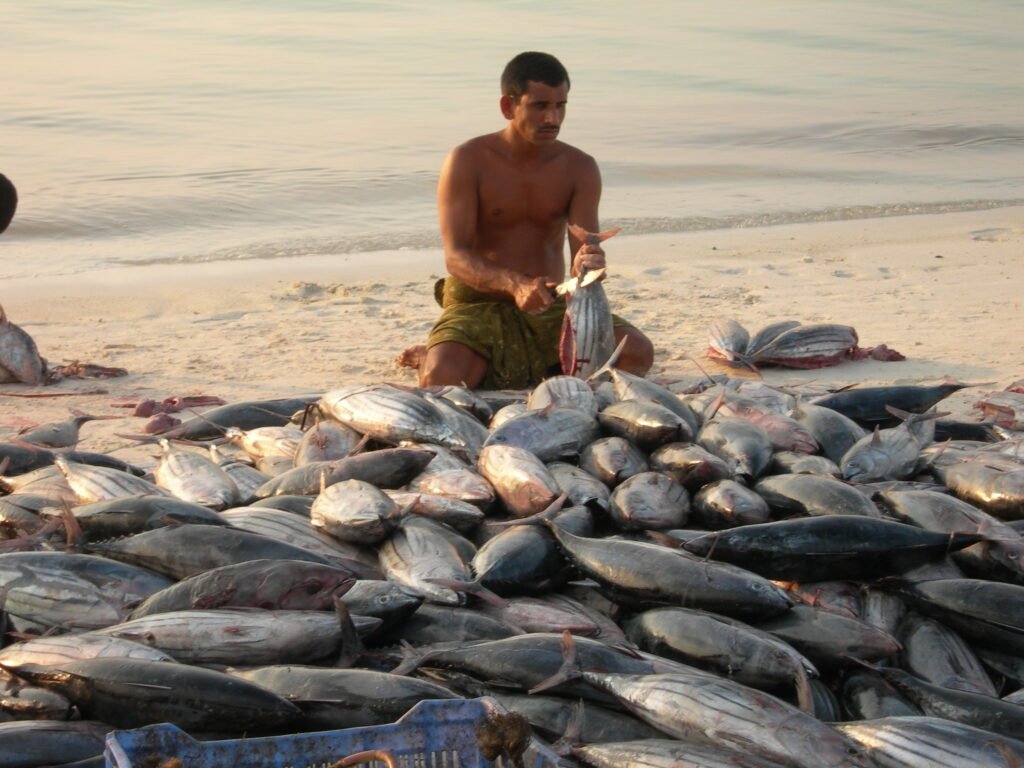
Fishing activities, overseen by the Department of Fisheries established in 1959, are carried out across all inhabited islands using the traditional pole-and-line fishing method, which exclusively targets tuna. This environmentally responsible method—found only in Lakshadweep within India—ensures negligible bycatch and long-term stock sustainability.
The Union Territory of Lakshadweep is emerging as a promising frontier for India’s Blue Economy. In a significant step towards unlocking its untapped fisheries potential, the Department of Fisheries, Government of India, organized the first-ever Investors’ Meet in Lakshadweep on 13 December 2025 at Bangaram Island.
Held in the august presence of Union Minister Shri Rajiv Ranjan Singh and Ministers of State Prof. S.P. Singh Baghel and Shri George Kurian, along with Shri Praful Patel, Hon’ble Administrator of Lakshadweep, the meet brought together 22 investors and entrepreneurs from across the country.
The event showcased four high-impact investment opportunities in fisheries and aquaculture—Tuna & Deep-Sea Fisheries, Seaweed Cultivation, Ornamental Fisheries, and Offshore Cage Farming—positioning Lakshadweep as a future hub for sustainable marine-based industries.

Conceptual Understanding of Sustainable Tuna
“Sustainable Tuna” refers to tuna harvested through fishing practices that ensure long-term stock health, minimal ecological disruption, and socio-economic equity. In Lakshadweep, sustainability is not a newly imposed framework but an inherent feature of traditional fishing systems practiced for centuries.
The dominant method used by fishers in Lakshadweep is pole-and-line fishing, a highly selective technique that targets individual tuna. From an academic and ecological standpoint, this method is considered one of the most sustainable forms of tuna fishing globally because it:
- Results in negligible bycatch
- Avoids habitat destruction
- Allows juvenile fish to escape
- Maintains natural population structures
These attributes align closely with contemporary sustainability principles articulated in marine conservation science and international fisheries governance.
Ecological and Environmental Significance
From an environmental perspective, Lakshadweep Sustainable Tuna represents a low-impact fisheries model. The coral reef ecosystems surrounding the islands are ecologically sensitive and highly productive. Large-scale industrial fishing methods, such as trawling or purse seining, pose serious risks to such ecosystems. In contrast, pole-and-line fishing preserves reef health and supports marine biodiversity.
Additionally, sustainable tuna fisheries contribute to climate resilience. Reduced fuel consumption, limited fishing effort, and shorter supply chains lower the carbon footprint of fishing operations. This aligns with global climate commitments and the emerging discourse on nature-positive economic models.
From Ocean to Global Plate
“Lakshadweep Sustainable Tuna” envisions a modern, integrated value chain, including:
- Responsible fishing
- Onboard handling and cold storage
- Certification and traceability
- Processing and canning
- Branding and packaging
- Export-oriented logistics
This transformation moves Lakshadweep beyond raw fish exports toward value-added products such as canned tuna, ready-to-eat items, and gourmet seafood.
Socio-Economic Dimensions
An essential academic dimension of Lakshadweep Sustainable Tuna lies in its community-centric framework. Fisheries in Lakshadweep are not merely economic activities but are embedded in the social and cultural life of island communities. Sustainable tuna development emphasizes value enhancement rather than volume expansion, thereby increasing fisher incomes without increasing fishing pressure.
By integrating modern infrastructure—such as cold chains, certification systems, and processing units—while retaining traditional fishing practices, the model promotes inclusive development. It creates employment across the value chain, including processing, logistics, quality control, and branding, while ensuring that fishers remain primary stakeholders rather than marginalized suppliers.
To enhance tuna catch efficiency and fisher safety, anchored Fish Aggregating Devices (FADs) have been deployed in select waters, reducing scouting time and fuel consumption. Complementing this, infrastructure such as ice plants, cold storage facilities, insulated boxes, and market linkages has strengthened post-harvest handling and exports. Supported by PMMSY, deep-sea vessels, modern processing initiatives, and satellite-based advisories are collectively transforming Lakshadweep’s tuna sector into a sustainable, technology-enabled pillar of India’s Blue Economy.
Global Market and Certification Context
In the global seafood market, sustainability has transitioned from a moral consideration to a market determinant. Certification systems such as the Marine Stewardship Council (MSC) play a crucial role in validating responsible fishing practices. Lakshadweep’s fisheries are particularly well-suited for such certification due to their traditional methods and low environmental impact.
From an academic standpoint, certification serves three functions:
- It provides scientific validation of sustainability claims
- It enables market access and price premiums
- It encourages continuous compliance with ecological benchmarks
Under the identity of “Lakshadweep Sustainable Tuna,” Indian tuna can enter premium international markets that prioritize traceability, ethical sourcing, and environmental stewardship.
Policy and Institutional Framework
The development of Lakshadweep Sustainable Tuna is supported by national initiatives such as the Pradhan Mantri Matsya Sampada Yojana (PMMSY) and recent policy efforts to promote the Blue Economy. Institutional mechanisms, including proposals for single-window clearance systems and investment facilitation, aim to balance economic growth with regulatory oversight.
Academically, this represents a shift from sectoral fisheries management to an integrated ocean governance approach, where ecological sustainability, economic viability, and social equity are addressed simultaneously.
Broader Significance for India’s Blue Economy
Lakshadweep Sustainable Tuna offers a replicable model for other coastal and island regions in India. It demonstrates that sustainability need not constrain economic opportunity; rather, it can serve as a competitive advantage. By combining traditional knowledge, scientific assessment, and modern market mechanisms, the model contributes to food security, export growth, and marine conservation.
Conclusion
In essence, Lakshadweep Sustainable Tuna is an educative example of sustainable development in practice. It reflects a paradigm where ecological integrity, cultural heritage, and economic aspirations coexist. For scholars, policymakers, and practitioners, it provides a valuable case study in designing fisheries systems that are resilient, equitable, and globally relevant—anchoring India’s Blue Economy in principles of responsibility and long-term stewardship.
Also Read: Lakshadweep Emerges as a New Investment Destination for India’s Blue Economy I Ambedkar Chamber