

₹80 crore Agarwood Value Chain Development Scheme at North Fulkabari, Tripura
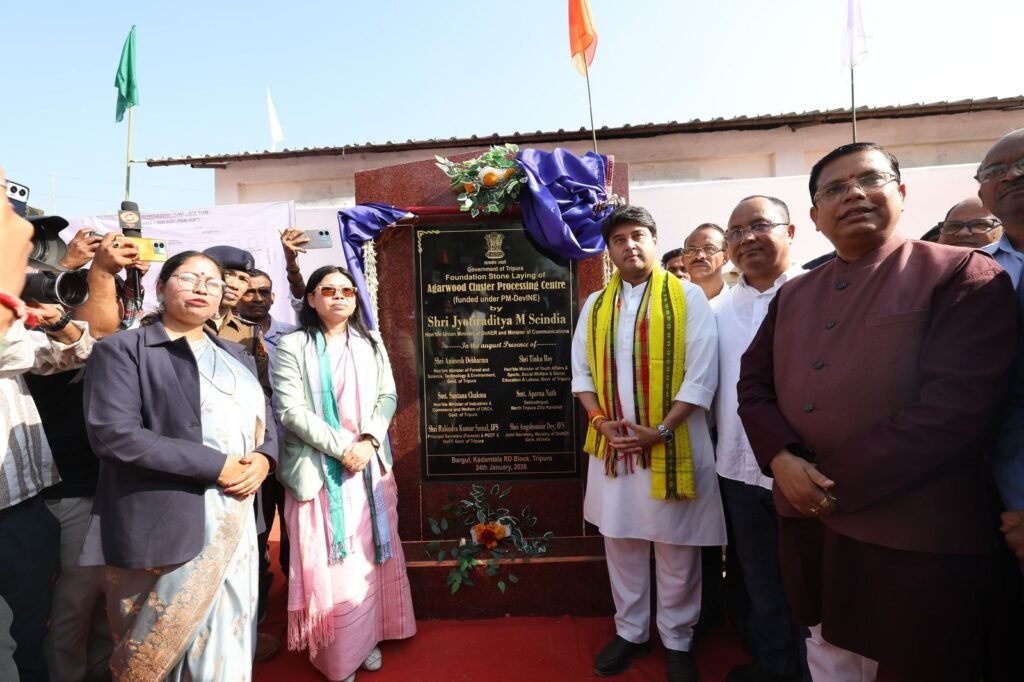
On January 24, 2026, Union Minister for Development of North Eastern Region (DoNER) and Communications, Jyotiraditya Scindia, laid the foundation stone of the ₹80 crore Agarwood Value Chain Development Scheme at North Fulkabari, Tripura. This initiative marks a major step toward transforming agarwood cultivation into a sustainable, farmer-friendly, and globally competitive industry.
This article explains the scheme in simple terms—what agarwood is, why it is valuable, how the scheme works, and why it matters for local communities, entrepreneurs, and India’s economic self-reliance.
What Is Agarwood and Why Is It So Valuable?
Agarwood is a rare and aromatic wood formed when certain trees get infected by a natural fungus.
It is one of the most expensive natural materials in the world.
Agarwood is used in:
- Perfumes and attars
- Incense sticks
- Ayurvedic and traditional medicines
- Religious and cultural rituals
Agarwood oil is often called “liquid gold” because of its high value in international markets, especially in the Middle East, Europe, and East Asia.


Northeast India: The Heart of India’s Agarwood Economy
India has around 150 million agarwood trees, and nearly 90% of them are located in the Northeastern states, mainly Tripura and Assam.
For years, farmers in these regions grew agarwood trees but:
- Did not get fair prices
- Depended heavily on middlemen
- Had limited access to processing and exports
The new scheme aims to change this reality.
What Is the ₹80 Crore Agarwood Value Chain Development Scheme?
This scheme focuses on developing the entire value chain—from trees in farmers’ fields to finished products sold in global markets.
Key Objectives:
- Increase agarwood production capacity by up to 50%
- Ensure farmers get full value for their produce
- Eliminate middlemen
- Promote local entrepreneurship
- Connect agarwood directly to international buyers
Central Processing Centres: Ending the Middleman System
Under the scheme, two Central Processing Centres (CPCs) will be set up:
- One in Golaghat, Assam
- One in Tripura
Why CPCs Matter:
- Farmers can process agarwood locally
- Quality control and branding improve
- Products can be directly marketed and exported
- Profits remain with farmers and local entrepreneurs
This creates value addition at the source, which is critical for inclusive economic growth.
GI Tag, Digital Platforms, and Export Expansion
To help agarwood reach global markets, the government has taken several important steps:
1. GI (Geographical Indication) Tag
- The GI process is underway
- This will protect the identity of Tripura and Assam agarwood
- It increases international trust and pricing power
2. Massive Increase in Export Quotas
- Agarwood chips exports increased from 25,000 kg to 1.5 lakh kg
- Agarwood oil exports increased from 1,500 kg to 7,500 kg
3. Digital Permissions and Platforms
- All permissions and sites are being integrated digitally
- Farmers can directly connect with global buyers
- Transparency improves, corruption reduces
‘Local to Global’ and One District One Product (ODOP)
Fulkabari’s agarwood sector is a live example of:
- Local to Global
- Vocal for Local
- One District One Product (ODOP)
What grows in small villages of Tripura can now reach perfume bottles in Paris, Doha, and Dubai.
This is grassroots economic empowerment in action.
₹2,000 Crore Annual Market Potential for Tripura
According to the Union Minister, within the next 3–4 years, Tripura’s agarwood sector alone has the potential to generate an annual turnover of ₹2,000 crore.
How This Will Happen:
- Direct buyer-seller meets
- International linkages (buyers from Qatar already engaged)
- Strong branding and quality assurance
This will create:
- New jobs
- New MSMEs
- New export-oriented businesses
Role of State Leadership and Cooperative Governance
Union Minister Scindia emphasized that under the leadership of Chief Minister Dr. Manik Saha, Tripura’s farmers will receive their rightful economic share.
The scheme reflects:
- Centre-State cooperation
- Long-term planning
- Focus on unique regional strengths
Why This Scheme Matters for India and Inclusive Economics
From the perspective of the Ambedkar Chamber of Commerce and Industry, this scheme is significant because it:
- Empowers small farmers and producers
- Encourages entrepreneurship among marginalized communities
- Builds ownership over natural resources
- Promotes economic dignity through enterprise
- Strengthens Atmanirbhar Bharat
Dr. B.R. Ambedkar believed that economic empowerment is the foundation of social justice.
This scheme translates that belief into action.
Development Beyond Agarwood: A Holistic Vision for Tripura
Alongside the agarwood project, several other development initiatives are underway:
- Projects worth ₹220 crore inaugurated
- Review of Agartala Government Inter College (₹192 crore)
- Review of Maternal & Child Health Hospital (₹200 crore)
- Upcoming ₹280 crore Matabari Tourism Circuit
This shows a balanced development approach—economy, education, health, and tourism.
You Learn: From Forests to Global Markets
The Agarwood Value Chain Development Scheme is not just about a tree.
It is about:
- Farmers’ income
- Regional pride
- Sustainable use of natural resources
- India’s global economic presence
By converting local knowledge into global value, Tripura is setting a powerful example for the entire country.
For India—and especially for historically marginalized communities—this is how development becomes inclusive, dignified, and durable.