

Policy Stability, Benign Inflation, and Growth Momentum Define India’s Economic Outlook
Indian Economy Stays Strong as RBI Holds Rates in First Monetary Policy of 2026
MUMBAI: At a time when the global economy is grappling with geopolitical tensions, trade disruptions, and financial market volatility, India stands out as a zone of stability and resilience. In his first monetary policy address of 2026, Sanjay Malhotra, Governor of the Reserve Bank of India, presented a confident yet cautious assessment of the Indian economy—highlighting strong growth, low inflation, and robust financial stability.
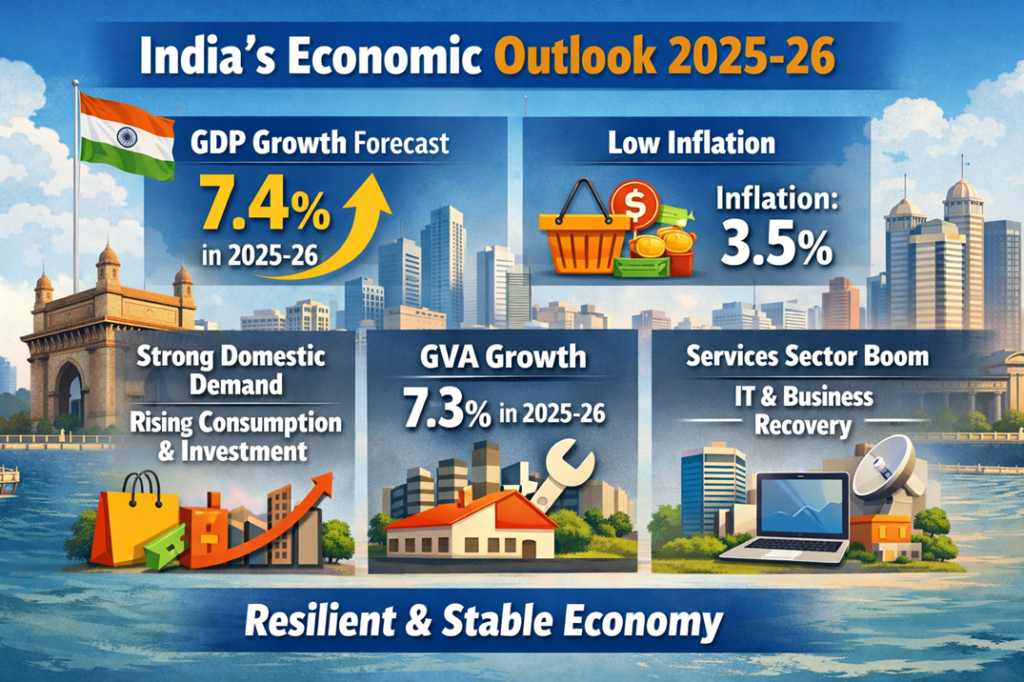
The Indian economy continues on a steadily improving growth trajectory, reaffirming its resilience in a challenging global environment. According to the Reserve Bank of India, real GDP is poised to grow by a robust 7.4 per cent in 2025-26, marking a significant improvement over the previous year. This growth has been largely driven by strong domestic demand, with private consumption and fixed investment emerging as the key growth engines.
While global uncertainties and trade disruptions persist, India’s internal economic drivers have helped offset external pressures. Net external demand remained a drag on growth, as imports continued to outpace exports. However, this reflects strong domestic demand rather than economic weakness.
On the supply side, real Gross Value Added (GVA) is estimated to grow by 7.3 per cent in 2025-26, supported by a strong performance of the services sector and a visible revival in manufacturing activity. The services sector continues to anchor growth, benefiting from rising domestic consumption and early signs of recovery in IT and business services.
A World in Flux, India on Steady Ground
Governor Malhotra opened the policy statement by acknowledging the rapidly changing global environment. Rising geopolitical frictions, trade-tariff uncertainties, and divergent monetary policies across major economies are reshaping the world economic order. Despite these challenges, he asserted that India is “in a good spot”, supported by strong domestic fundamentals.
Global growth in 2026 is expected to be marginally stronger than earlier projections, driven by technology investments, fiscal stimulus, and accommodative financial conditions. However, inflation remains above target in most advanced economies, forcing central banks to adopt divergent policy paths. Against this backdrop, India’s macroeconomic stability emerges as a key strength.
MPC Decision: Status Quo with a Neutral Stance
The Monetary Policy Committee met on February 4, 5 and 6, and after detailed deliberations, voted unanimously to keep the policy repo rate unchanged at 5.25 per cent.
- Standing Deposit Facility (SDF): 5.00%
- Marginal Standing Facility (MSF) & Bank Rate: 5.50%
- Policy Stance: Neutral
Governor Malhotra explained that the current policy rate is appropriate given the evolving macroeconomic conditions. The MPC will continue to remain data-driven, especially as India transitions to a new GDP and CPI series.
Why RBI Chose to Hold Rates
Explaining the rationale, the RBI noted that external headwinds have intensified since the last policy meeting. However, the successful completion of major trade deals has improved the medium-term outlook. Overall, near-term domestic inflation and growth conditions remain positive.
The MPC assessed that the current policy rate remains appropriate, given the evolving balance between growth support and price stability.
Growth Outlook: India Poised for Sustained Expansion
GDP Growth at 7.4% in 2025-26
India’s real GDP is estimated to grow by 7.4 per cent in 2025-26, marking a significant improvement over the previous year. Growth has been driven largely by private consumption and fixed investment, even as net exports remain a drag due to higher imports.
On the supply side, real Gross Value Added (GVA) is estimated to grow by 7.3 per cent, supported by:
- Strong services sector performance
- Revival in manufacturing activity
- Firm construction sector growth
Optimism for 2026-27
Looking ahead, economic activity is expected to remain resilient in 2026-27. Agriculture is set to benefit from healthy reservoir levels, robust rabi sowing, and improving crop conditions. Manufacturing is likely to gain from improving corporate balance sheets and sustained momentum in the informal sector. Services, including IT, are showing early signs of renewed strength.
Private consumption—both rural and urban—is expected to remain strong, supported by improving labour market conditions, GST rationalisation, and monetary easing.
Inflation: Benign and Well-Anchored
CPI Remains Below Tolerance Band
Headline CPI inflation remained below the tolerance band during November–December 2025. While inflation firmed up marginally, this was mainly due to food prices and precious metals.
Governor Malhotra highlighted that core inflation (excluding gold) remained stable at 2.6 per cent, indicating muted underlying price pressures.
Inflation Projections
- CPI Inflation (2025-26): 2.1%
- Q4:2025-26: 3.2%
- Q1:2026-27: 4.0%
- Q2:2026-27: 4.2%
The slight upward revision in inflation outlook is largely attributed to rising prices of precious metals, which alone contribute 60–70 basis points. Excluding this factor, inflation pressures remain well-contained.
External Sector: Resilient and Well-Capitalised
Despite global uncertainty, India’s external sector remains robust:
- Merchandise exports: Grew by 1.9% (y-o-y) in Q3:2025-26
- Merchandise imports: Grew by 7.9%, widening the trade deficit
- Services exports and remittances: Remain strong
Foreign exchange reserves stood at US$ 723.8 billion as of January 30, 2026, providing over 11 months of import cover. FDI inflows remain healthy, especially in greenfield projects, underscoring global confidence in India’s long-term growth story.
Liquidity and Financial Markets: RBI Remains Proactive
System liquidity has remained in surplus, aided by several durable liquidity-augmenting measures undertaken by the RBI. The cumulative 125 basis points cut in the repo rate has led to significant transmission:
- WALR on fresh loans: Down by 105 bps
- Deposit rates: Also softened considerably
While money market rates tightened temporarily due to seasonal factors, the RBI reaffirmed its commitment to ensuring adequate liquidity to support productive economic activity.
Financial Stability: Banking System on Strong Footing
Governor Malhotra reassured that the Indian financial system remains sound:
- Banks and NBFCs show strong capital adequacy
- Asset quality has improved
- Credit growth accelerated to 13.8% (y-o-y), driven by retail, services, MSMEs, and large industries
Key Announcements: Empowering Consumers and Markets
The RBI announced a series of forward-looking measures, including:
- Draft guidelines on mis-selling, loan recovery, and digital fraud protection
- Proposed ₹25,000 compensation for small-value digital fraud losses
- Increase in collateral-free MSME loan limit from ₹10 lakh to ₹20 lakh
- Permission for banks to lend to REITs
- Major reforms for Urban Cooperative Banks (UCBs), including Mission-SAKSHAM
- Ease of doing business for select NBFCs
- Deepening of financial markets through ECB reforms and corporate bond derivatives
©ambedkarchamber.com