


Government Moves to Reassess Market Dynamics, Technology Levels and Worker Welfare in Decentralised Textile Backbone
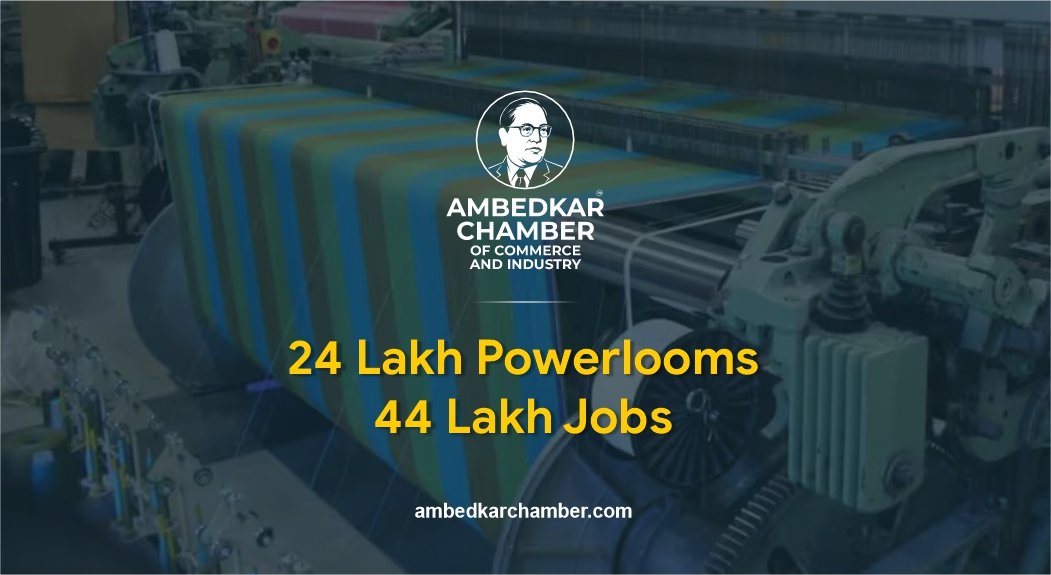
NEW DELHI: India’s powerloom sector, one of the largest employment generators in the textile industry, continues to support around 44 lakh workers across the country, according to the last comprehensive baseline survey conducted in 2013. The survey had identified nearly 24 lakh powerlooms operating nationwide, underscoring the sector’s critical role in sustaining livelihoods, particularly in small towns and semi-urban clusters.
This information was provided by the Minister of State for Textiles, Shri Pabitra Margherita, in a written reply to a question in the Rajya Sabha.
Recognising the urgent need to reassess the sector amid changing global trade patterns, technological shifts and evolving socio-economic conditions of workers, the Ministry of Textiles has now moved forward with a fresh baseline survey framework. The framework has been prepared by the Textiles Committee and has received in-principle approval, with the terms of reference already finalised.
Officials said the proposed survey will provide updated insights into production capabilities, market competitiveness, technology adoption and labour conditions. The findings are expected to guide future policy interventions, especially for the decentralised powerloom ecosystem that remains vulnerable to market volatility and rising input costs.

Government Tracking Impact of Global Tariffs on Powerloom and Textile Exports
The government is closely monitoring the impact of global tariff changes on India’s textile and powerloom exports, acknowledging that export performance is influenced by multiple interlinked factors. These include product differentiation, quality standards, demand patterns and contractual trade arrangements, officials said.
India’s powerloom sector, which contributes significantly to fabric production, is particularly sensitive to international price fluctuations and trade barriers. Any increase in tariffs in key export markets can affect order volumes, margins and employment at the grassroots level. The Ministry of Textiles has indicated that export data for Textiles and Apparel, including powerloom products, is being regularly reviewed to assess sectoral stress and competitiveness.
Industry experts note that while tariffs play a role, the sector’s ability to adapt through innovation, quality upgrades and cost efficiency will ultimately determine its global standing. The upcoming baseline survey is expected to offer granular data on export readiness and technological preparedness of powerloom units, helping policymakers fine-tune export promotion strategies and mitigate external trade risks.
GST Council Rationalisation Aims to Lower Costs and Boost Competitiveness
A major relief for the textile and powerloom sector came through GST rate rationalisation recommended by the 56th GST Council meeting held on September 3, 2025. The Council approved measures aimed at removing structural distortions, reducing production costs and enhancing India’s global competitiveness.
One of the key changes includes raising the threshold for the 5 per cent GST slab on readymade garments and made-ups from ₹1,000 to ₹2,500 per piece, offering relief to both consumers and manufacturers. This move is expected to stimulate demand in the mass consumption segment, where powerloom-based products have a strong presence.
Further, to address the long-standing Inverted Duty Structure (IDS), GST rates on Man-Made Fibres (MMF) and MMF yarns have been sharply reduced to 5 per cent, from earlier rates of 18 per cent and 12 per cent, respectively. This alignment across fibre, yarn and fabric stages is expected to ease working capital pressures and improve profitability for manufacturers.
Institutional Support Through ITADCs Strengthens Powerloom Clusters
To support small and medium textile units and decentralised powerloom clusters, the Ministry of Textiles continues to extend institutional assistance through the Office of the Textile Commissioner. Services are delivered via 44 Integrated Textile and Apparel Development Centres (ITADCs) located across major powerloom hubs in the country.
These centres provide critical services such as testing laboratories, skill training, design development, technical troubleshooting and awareness programmes. They also conduct Powerloom Sample Surveys, which help assess production quality and market alignment.
Officials said ITADCs play a vital role in bridging the gap between traditional powerloom units and modern textile requirements. By facilitating access to testing and design expertise, these centres help smaller units comply with quality standards demanded by domestic and export markets. The decentralised nature of the powerloom sector makes such institutional support essential for sustaining productivity, improving incomes and enabling gradual technological upgradation without displacing workers.
PowerTex India and Cluster Schemes Drive Capacity Building
The government has implemented multiple schemes over the years to enhance the capacity and competitiveness of the decentralised powerloom sector. The PowerTex India Scheme, launched on a pan-India basis for 2017–20 and later extended till 2021, aimed to improve productivity, modernisation and market access.
The scheme has since been subsumed under the Textile Cluster Development Scheme (TCDS), with support now limited to completing ongoing projects and meeting committed liabilities. In addition, several complementary initiatives continue to support the sector, including the Amended Technology Upgradation Fund Scheme (ATUFS), Group Workshed Scheme, PM Credit Scheme for Powerloom Weavers, In-situ Upgradation Fund Scheme, and the Comprehensive Powerloom Cluster Development Scheme (CPCDS).
Together, these schemes focus on technology modernisation, infrastructure development, credit access and cluster-based growth. Officials said sustained implementation of these initiatives is crucial for ensuring the long-term viability of the powerloom sector, which remains the backbone of India’s textile value chain.
STATEWISE POWERLOOM INDUSTRY AT GLANCE
| STATE | UNITS | TOTAL LOOMS | TOTAL EMPLOYMENT | SHUTTLELESS LOOMS |
|---|---|---|---|---|
| UP | 59,038 | 1,90,874 | 5,77,748 | 2,690 |
| RAJASTHAN | 945 | 22,980 | 54,456 | 16,434 |
| HARYANA | 1,600 | 25,510 | 42,533 | 1,128 |
| PUNJAB&HP,J&K | 1,162 | 14,511 | 25,025 | 1,251 |
| MP | 8,344 | 39,979 | 1,66,147 | 1,063 |
| NORTH ZONE TOTAL | 71,089 | 2,93,854 | 8,65,909 | 22,566 |
| GUJARAT | 34,966 | 5,24,102 | 6,63,068 | 34,331 |
| MAHARASHTRA | 1,49,613 | 9,48,891 | 15,54,938 | 35,429 |
| CHATTISGARH | 49 | 166 | 324 | NA |
| WEST ZONE TOTAL | 1,84,628 | 14,73,159 | 22,18,330 | 69,760 |
| ORISSA | 824 | 1,793 | 3,792 | NA |
| WB | 3,509 | 12,690 | 20,141 | 25 |
| BIHAR | 3,839 | 20,511 | 42,770 | 12 |
| ASSAM/NE | 30 | 464 | 868 | NA |
| EAST ZONE TOTAL | 8,202 | 35,458 | 67,571 | 37 |
| TAMIL NADU | 89,449 | 5,62,513 | 10,18,961 | 8,794 |
| ANDHRA PRADESH | 12,635 | 48,176 | 83,850 | 1,435 |
| KARNATAKA | 18,566 | 68,795 | 1,53,045 | 199 |
| KERALA | 1,027 | 4,463 | 7,865 | 350 |
| SOUTH ZONE TOTAL | 1,21,677 | 6,83,947 | 12,63,721 | 10,778 |
| ALL INDIA | 3,85,596 | 24,86,418 | 44,18,240 | 1,03,141 |
Table Analysis: Maharashtra, Tamil Nadu and Gujarat Lead Powerloom Landscape
The state-wise data highlights Maharashtra as the largest powerloom hub, with nearly 9.5 lakh looms and employment exceeding 15.5 lakh workers, reflecting the scale and industrial depth of the sector in the state. Tamil Nadu and Gujarat also emerge as major centres, combining high loom density with significant adoption of shuttleless looms, indicating relatively better technology penetration.
Northern states such as Uttar Pradesh continue to play a crucial role in employment generation, while eastern and northeastern regions show limited presence, pointing to regional imbalances. The overall national figure of over 24.8 lakh looms and 44 lakh workers underscores the sector’s socio-economic importance.
Experts say the data reinforces the need for region-specific interventions, with technology upgradation in traditional clusters and infrastructure development in emerging regions. The proposed baseline survey is expected to update this decade-old picture and provide a sharper roadmap for policy action.
©ambedkarchamber.com