


Over 99% Broad-Gauge Network Electrified, Marking a Major Leap Towards Clean and Efficient Rail Transport
Indian Railways has envisioned becoming a net-zero carbon emitter, combining electrification with renewable energy, modal shift of cargo and passenger traffic to rail, and exploration of hydrogen-powered train sets as part of its climate strategy.
NEW DELHI: Indian Railways, the World’s Fourth-Largest Rail Network, is on the verge of completing the electrification of its entire broad-gauge network, with more than 99 per cent of the routes already electrified and the remaining stretches expected to be covered shortly, according to official data released on Saturday.
Indian Railways ranks as the world’s fourth-largest rail network by route length, after the United States, China, and Russia.
The electrification push is part of a formal mission aimed at achieving net-zero emissions (Scope 1) for Indian Railways.
Massive Electrification Achieved at Unprecedented Speed
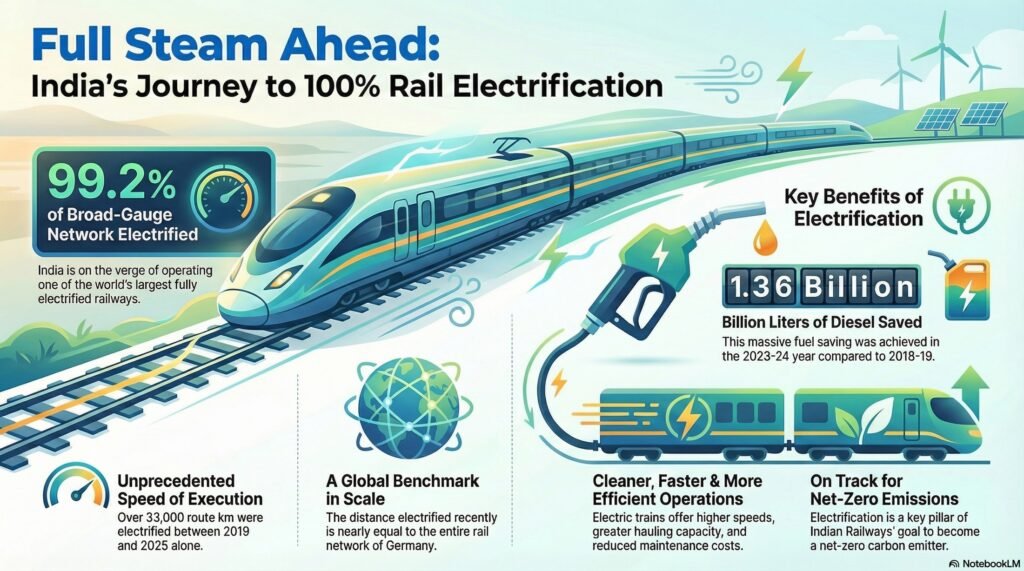
Between 2019 and 2025, Indian Railways electrified over 33,000 route kilometres, achieving an average pace of more than 15 route kilometres per day. Officials said the scale of this expansion is comparable to electrifying an entire national railway network of a developed country, noting that the distance electrified during this period is nearly equal to the total rail network of Germany.
At present, 99.2 per cent of India’s broad-gauge railway network has been electrified, covering 25 states and Union Territories, placing India among global leaders in railway electrification.
World’s Largest Rail Networks (by Route Length)
| Rank | Country | Approx. Rail Network Length (km) | Key Characteristics |
|---|---|---|---|
| 1 | United States | ~250,000 km | Largest freight rail network; privately operated |
| 2 | China | ~155,000 km | World’s largest high-speed rail network |
| 3 | Russia | ~87,000 km | Home to the Trans-Siberian Railway |
| 4 | India | ~68,000 km | Largest passenger carrier; over 99% electrified |
| 5 | Canada | ~49,000 km | Freight-centric network linking ports and industries |
| 6 | Germany | ~38,000 km | Highly electrified and efficient rail system |
| 7 | France | ~28,000 km | Strong high-speed (TGV) network |
| 8 | Japan | ~27,000 km | Renowned for punctual and high-speed services |

Global Benchmark in Clean Rail Infrastructure
India’s progress is significant even when compared with nations that have long-established railway systems. Despite operating one of the world’s largest and busiest rail networks, Indian Railways has managed to electrify almost its entire broad-gauge system within a short span of time.
In contrast, several advanced economies continue to rely substantially on diesel traction due to cost constraints or structural limitations. India’s approach, officials said, reflects clear policy direction, sustained investment, and consistent execution.
Reduced Diesel Use, Lower Emissions and Cost Savings
The transition to electric traction has resulted in a substantial reduction in diesel consumption, leading to lower greenhouse gas emissions and significant savings in operating costs. Electrification has also improved the efficiency, speed, and reliability of train operations, benefiting both passenger and freight services.
Officials noted that electric locomotives offer higher hauling capacity, reduced maintenance requirements, and better energy efficiency compared to diesel engines.
Electrification has concretely reduced fuel consumption: Indian Railways reportedly saved 136 crore litres of diesel in the year 2023-24 alone compared to 2018-19, thanks to intense electrification and energy efficiencies.
Electrification supports higher train speeds, increased haulage capacity and faster travel times, strengthening both passenger comfort and freight logistics.
Towards Net-Zero Carbon Emissions
In parallel with electrification, Indian Railways is pushing renewable procurement — including tying up around 1,500 MW of renewable capacity via power purchase agreements (PPAs) and exploring solar, wind and nuclear energy partnerships to power operations sustainably.
With the completion of the remaining electrification works, Indian Railways is set to operate one of the world’s largest fully electrified railway networks. This milestone is a key pillar of Indian Railways’ long-term objective of becoming a net-zero carbon emitter, in line with India’s broader climate commitments.
The fully electrified network is expected to support cleaner, faster, and more sustainable mobility for millions of passengers every day, while also strengthening the country’s logistics and freight transportation system.