


A quantum-powered economy ultimately uses quantum science to transform economic productivity, national resilience, and global technological influence.
Global demand for quantum professionals is projected to reach 600,000 by 2040, and India must deploy at least 120,000 trained individuals to secure its competitive edge.
Building India’s Quantum Vision
India’s journey toward becoming a leading quantum-powered economy began with a strategic realization that the 21st century would be shaped by deep technologies capable of redefining national power, economic competitiveness, and scientific leadership. The Government of India identified quantum technologies early as a frontier domain critical for national security, secure communication, advanced computing, and next-generation industries. This understanding led to the launch of the National Quantum Mission (NQM) in April 2023, with an allocation of INR 6,003.65 crore to support quantum research, innovation, startups, and infrastructure until 2031.
For India, the promise of quantum goes far beyond technology.
According to the NITI Aayog–IBM roadmap – Transforming India into a Leading Quantum-Powered Economy (NITI Aayog – IBM, December 2025), this initiative aimed to seed, nurture, and scale India’s capabilities in quantum computing, quantum sensing, quantum communication, and quantum materials. Over time, multiple government bodies—including DRDO, ISRO, MeitY, DST, and state governments—began establishing hubs, testbeds, research parks, and industry collaborations, signaling a coordinated national approach.
The roadmap published by NITI Aayog lays out clear imperatives and actionable pathways for realizing this vision by leveraging the existing National Quantum Mission. It provides a comprehensive analysis of India’s current position, strategic strengths, and critical gaps, and identifies key interventions to accelerate R&D, commercialization, and ecosystem development.
The roadmap emphasizes collective ownership—across policymakers, scientists, entrepreneurs, investors, and states—to build a globally trusted and competitive quantum economy. The Roadmap for Transforming India into a leading Quantum-Powered Economy was developed by NITI Aayog’s Frontier Tech Hub, in collaboration with IBM, with guidance from an Expert Council of leaders from industry and academia.
As global investments surged past USD 10 billion annually, India recognized the urgency to accelerate its quantum initiatives to avoid strategic dependence and ensure leadership in global standards, supply chains, and applications.
***
What is a Quantum-Powered Economy?
A Quantum-Powered Economy is an advanced economic model where national growth, technological competitiveness, and strategic strength are driven by the widespread development and deployment of quantum technologies—including quantum computing, quantum communication, quantum sensing, and quantum materials.
It represents a future-ready economic structure in which quantum innovation directly enhances industrial productivity, national security, and scientific breakthroughs.
A quantum-powered economy transforms traditional sectors by enabling computational and analytical capabilities far beyond classical systems. It accelerates problem-solving in medicine, logistics, energy, climate science, finance, defence, and materials research, creating unprecedented economic and societal value.
It also builds a highly skilled workforce and nurtures deep-tech startups, strengthening technological sovereignty and global leadership.
***
Table 1: Key Features of a Quantum-Powered Economy
A quantum-powered economy ultimately uses quantum science to transform economic productivity, national resilience, and global technological influence.
| Feature | Description |
|---|---|
| Quantum Computing | Solves complex problems in optimisation, chemistry, finance, and artificial intelligence at speeds unattainable by classical computers. |
| Quantum Communication | Provides ultra-secure communication networks using Quantum Key Distribution (QKD) and entanglement-based technologies. |
| Quantum Sensing | Enables extremely precise navigation, medical diagnostics, mineral exploration, and environmental monitoring with high sensitivity. |
| Quantum Materials | Supports development of advanced devices, sensors, processors, and next-generation photonic and semiconductor technologies. |
| Deep-Tech Ecosystem Growth | Powered by quantum startups, research institutions, innovation hubs, global capability centres, and industry partnerships. |
| Enhanced National Security | Strengthens defence through quantum-secure communication, advanced sensing, GPS-free navigation, and strategic intelligence systems. |
| Global Competitiveness | Elevates national leadership in global standards, supply chains, export capabilities, and high-value innovation-driven markets. |
India’s Vision: A Quantum-Powered Nation by 2035
India’s aspiration to become a leading quantum-powered economy by 2035 emerges from the recognition that quantum technologies—computing, communication, sensing, and materials—are poised to reshape global technological and economic ecosystems.
The roadmap highlights that quantum computing is expected to deliver quantum advantage by 2026–28, enabling breakthroughs in optimization, drug discovery, and material science far beyond classical computing capabilities.
By 2035, India aims to position itself among the world’s top quantum nations by developing a robust innovation ecosystem, strengthening domestic manufacturing of quantum hardware, and expanding high-skilled talent.
This vision includes deploying quantum technologies across defence, healthcare, logistics, and finance, while anchoring India’s position in international markets as a trusted, scalable, and affordable quantum solutions provider.
The government aims to incubate 10+ globally competitive quantum startups, capture 50% of the global quantum software market, and achieve dominance in crucial supply chain areas such as cryogenics, qubit components, and PQC infrastructure.
Ambition at Global Scale
The roadmap lays out five concrete “Visions for 2035”, each measurable and time-bound.
Ten Global Quantum Champion Startups
India aims to incubate 10 quantum startups achieving USD 100M+ cumulative revenue and global competitiveness. This goal reflects India’s potential to excel in quantum algorithms, software, and middleware—areas that complement India’s established IT strength.
India to Capture 50% of Global Quantum Software Market
The software segment—algorithms, cloud services, simulators, optimization modules—will offer the highest value. The report emphasizes India’s natural advantage: a massive software engineering base, a mature IT industry, and high adoption of cloud-based R&D platforms.
Deployment of Quantum Technologies Across Strategic Sectors
Quantum solutions must reach at least three major sectors—including defence, healthcare, materials, energy, pharma, logistics, and finance.
Quantum Atmanirbharta and Global Supply Chain Control
This goal includes leadership in:
Quantum processors
Cryo-electronics
Quantum communication modules
Photonic components
PQC (post-quantum cryptography) libraries
Becoming a Hub of Foundational Scientific Breakthroughs
India aspires to produce globally recognized quantum science—frequent publications in Nature, Science, PRL, and notable contributions in quantum algorithms and materials research.
***
Understanding the Technology Landscape: The Quantum Stack
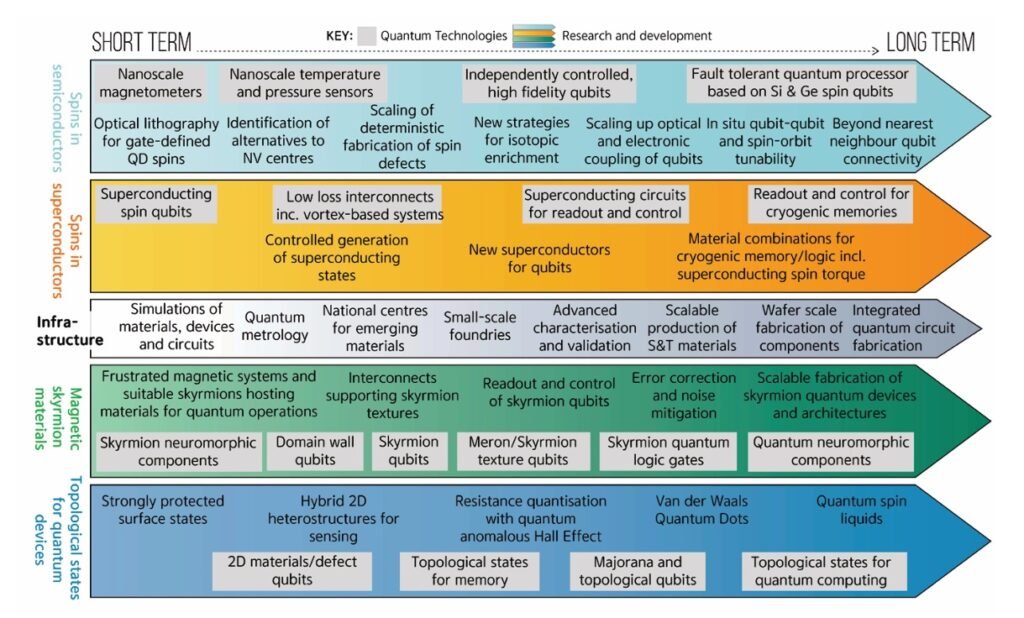
The report includes a detailed Quantum Stack diagram showing six major layers—from materials to industry applications. This helps identify India’s current gaps and opportunities.
Quantum Hardware Layer
Includes:
- materials (diamonds, superconductors, 2D materials)
- qubit devices (spin, photonic, superconducting)
- India has emerging players (e.g., Pristine Diamonds, Quan2D), but lacks large-scale fabrication capabilities.
- Non-Quantum Hardware Layer
- Includes cryogenics, RF control systems, lasers, wiring, optical systems, microwave electronics.
The roadmap stresses that India imports almost all of these peripherals today—creating a major bottleneck.
Providers Layer
Startups like QNu Labs, QPiAI, BosonQ Psi, QKrishi appear here, offering early products in QKD, quantum algorithms, and quantum-aware optimization tools.
End-User Layer
Industries such as BFSI, pharma, chemicals, logistics, defence and aviation will form India’s largest quantum consumers.
***
Building a Robust Quantum Workforce for National Competitiveness
India’s ability to lead the quantum future depends heavily on its scientific and engineering talent pool. The roadmap emphasizes that while India produces over 91,000 STEM graduates annually in quantum-relevant disciplines—second only to the European Union—the nation must significantly expand interdisciplinary training in quantum engineering, materials science, cryogenics, microwave electronics, and quantum algorithms.
Global demand for quantum professionals is projected to reach 600,000 by 2040, and India must deploy at least 120,000 trained individuals to secure its competitive edge.
Charts in the report show India as the second-largest user base of IBM Quantum systems, reflecting widespread academic and industry interest. Yet usage hours remain low, indicating the need for more funded projects, access to advanced hardware, sponsored research labs, and fellowship programs.
India’s workforce strategy includes creating quantum engineering degrees, large-scale certification programs, and industry-linked skilling pipelines to ensure talent transitions from labs to real-world deployments.
***
Industry Adoption and Investment
Catalyzing Quantum Transformation
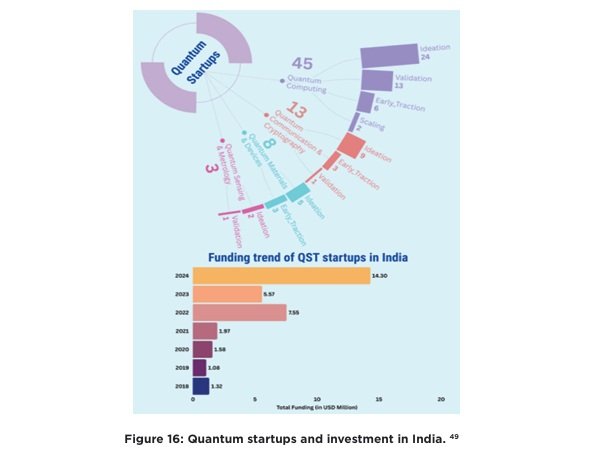
For India to achieve quantum leadership by 2035, strong industry participation is essential. The roadmap notes that despite India’s thriving IT services ecosystem, quantum adoption remains at an early stage due to limited awareness, risk perceptions, and lack of validated commercial use cases. The government aims to bridge this gap by establishing 25+ industry-focused pilots by 2030, creating sectoral sandboxes, and encouraging joint R&D between enterprises, startups, and academic hubs.
Global benchmarks show that countries like the US and Japan have thriving quantum-industrial ecosystems supported by massive private investments; India must replicate this by leveraging its 1,800+ Global Capability Centres (GCCs).
The iDEX programme already connects startups with defence needs, enabling GPS-free navigation, QKD trials, and quantum sensing prototypes. To scale significantly, India requires tax incentives, procurement reforms, challenge grants, and wider engagement of public sector units (PSUs) such as Indian Railways, ONGC, nationalized banks, and power utilities.
***
India’s Current Status: Strengths and Barriers
Table 2: India’s Current Strengths in the Quantum Ecosystem
| Strengths | Details |
|---|---|
| Large STEM Talent Base | India ranks 2nd globally in quantum-relevant STEM graduates, producing 91,000 graduates annually. |
| High Quantum Learning Adoption | India is the 2nd largest user base of IBM Quantum systems, reflecting strong national interest in quantum computing. |
| Mature IT Services Sector | IT giants like Infosys, TCS, Wipro, LTIMindtree operate active quantum Centres of Excellence (CoEs). |
| State-Level Quantum Investments | Karnataka’s Quantum Research Park and Andhra Pradesh’s Amaravati Quantum Valley show early regional leadership. |
| Government Support via iDEX | Defence-driven innovation programmes allow startups to co-develop quantum technologies with strategic users. |
Table 3: India’s Current Barriers and Weaknesses in the Quantum Ecosystem
| Weaknesses | Details |
|---|---|
| Hardware and Component Gaps | India lacks capabilities in cryogenics, quantum materials, qubit fabrication, and precision devices. |
| Low Research Funding | R&D spending stands at 0.65% of GDP, far behind China (2.6%) and South Korea (5.2%). |
| Complex Regulatory Processes | Lengthy procurement and audit procedures slow research progress and increase operational burdens. |
| Weak Lab-to-Market Pipeline | Limited translational research funding, slow validation pathways, and insufficient industry collaboration. |
| Poor IP Performance | India is not in the top 10 for global quantum patents, indicating weak IP generation capacity. |
| Startup Redomiciling (“Flipping”) | Many deep-tech startups shift domicile abroad, causing loss of Indian IP and future economic value. |
***
Quantum Technologies in Strategic Sectors
Securing India’s Future
The report highlights that defence, intelligence, and national security will be the earliest and largest adopters of quantum technologies. By 2035, quantum sensing systems—such as ultra-sensitive magnetometers, gravimeters, and atomic clocks—will enable GPS-independent navigation for submarines and aircraft, enhancing India’s strategic capabilities.
Quantum communication, particularly Quantum Key Distribution (QKD), will protect sensitive data across government networks. India has already demonstrated 380 km fibre-based QKD and 1 km free-space QKD, and aims to achieve 2,000 km secure links similar to global leaders like the US and China. DRDO, ISRO, and academic institutions like IIT Delhi and RRI have accelerated prototype development.
Quantum computing will further support computational fluid dynamics, cryptography, and real-time battlefield simulation. The roadmap warns that failure to adopt quantum-secure communication early could expose India to catastrophic cyber vulnerabilities as adversaries advance their quantum capabilities.
***
Quantum in Healthcare, Logistics, Finance & Beyond
A New Economic Frontier
Quantum technologies are projected to create USD 1–2 trillion in global economic value, with India poised to capture a substantial share across healthcare, logistics, aviation, BFSI, chemicals, and energy.
The report illustrates how quantum algorithms could revolutionize drug discovery by simulating molecular interactions previously impossible for classical computers—enabling personalized medicine even in rural areas, as shown in the Rajasthan case study.
In logistics, quantum optimization can transform national initiatives like PM GatiShakti, reducing India’s historically high logistics cost of 13–18% of GDP toward the global benchmark of 8%.
In finance, quantum machine learning could enhance fraud detection, portfolio optimization, and credit scoring. Aviation will benefit from disruption handling, route optimization, and predictive maintenance.
These sectoral transformations will not only boost GDP but also create advanced jobs, strengthen India’s export competitiveness, and embed quantum innovation into India’s Digital Public Infrastructure (DPI).
***
Strengthening India’s Research Ecosystem: Closing the Quality Gap
Although India publishes a large volume of scientific literature, only 9–12% of its quantum-relevant research appears in top global journals. The roadmap emphasizes that India must significantly expand funding for exploratory research, doubling R&D spending (currently 0.65% of GDP) to match global leaders like China and South Korea.
The Ease of Doing Science Index, highlighted in the report, shows Indian institutions scoring 22.4 points lower than global institutions due to procurement delays, rigid fund utilization norms, and limited institutional support.
India needs reforms that allow flexible funding, fast-track approvals, equipment sharing among institutions, and incentive structures that reward both high-risk research and industry collaboration.
The establishment of ANRF (Anusandhan National Research Foundation) is expected to streamline national research governance. Successful quantum leadership requires India to enable rapid lab-to-market translation through better IP frameworks, longer research sabbaticals, and federated national quantum testbeds.
***
Global Standards, Supply Chain Leadership & Strategic Diplomacy
India’s quantum aspirations require leadership not only in technology development but also in shaping global standards. The roadmap stresses that once international standards are set—by bodies such as IEC, ISO, and ITU—they become difficult to change.
India must therefore actively participate in standards-setting to ensure market access for domestic products. In supply chains, the report’s materials diagram shows global dependency on rare materials largely processed in China.
Without strategic partnerships and local manufacturing, India risks future vulnerabilities. The roadmap proposes developing a Quantum Supply Chain Resilience Plan, building cryogenic component industries, and integrating Indian companies into global value chains.
India must also drive quantum diplomacy with the Quad, EU, ASEAN, and African nations, positioning itself as a trusted quantum partner for the Global South. These measures will consolidate India’s international influence and reduce long-term strategic dependence.